


Newsletter
2018 Kashube Lecture Notes
Polish/Kashube Emigration
and Immigration to Milwaukee
“One Story with Three Strains”
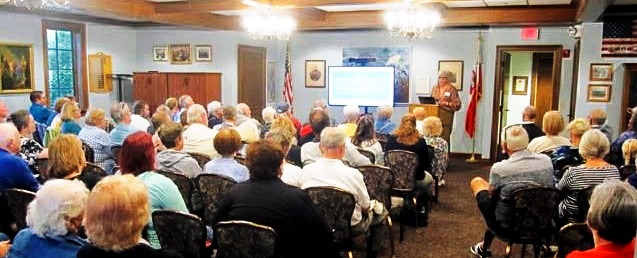
Speakers during the lecture that took place on September 6, 2018 included:
Prof. Anne Gurnack, Professor Emerita (Political Science), University of Wisconsin Parkside;
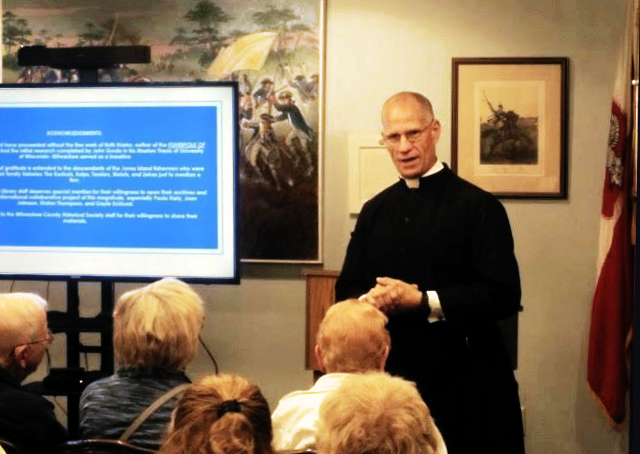
Abbé George Baird, Administrator St. Stanislaus Church of Milwaukee;
Sebastian Tyrakowski, Deputy Director of the Emigration Museum in Gdynia Poland.
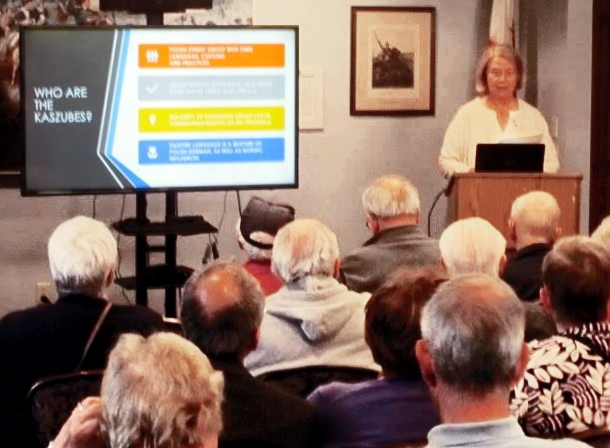
Moderator: Dr. Angela Pienkos, Educator, Past President of the Polish American Historical Association and Past Executive Director of the Polish Center of Wisconsin.
LECTURE NOTES
by David Rydzewski
The Kashubian people are a Polish ethnic group with its own language, customs and traditions. Since 2005, the distinctive dialect they speak is officially recognized as the regional language.
The Kashubes that settled on Milwaukee’s Jones Island, came from the Hel Peninsula area of Poland. The Hel Peninsula is a long narrow strip of land that separates the Bay of Puck from the open Baltic Sea, They came to the area of Milwaukee that allowed them to do what they knew best, 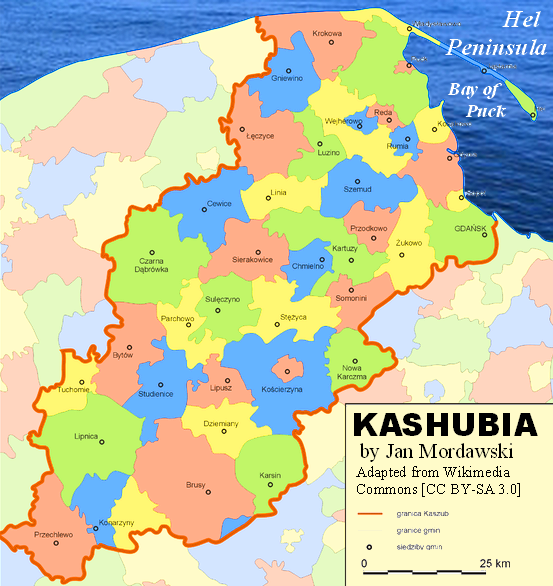 fishing. The Kashube emigration started in the 1870’s. Many of the first Kashube emigrants originated in southern Kashubia (furthest away from the Baltic coast) and settled in Canada. They later found the land in Canada not well suited for farming, and many of them resettled in Stevens Point, Wisconsin or Winona, Minnesota.
The Kashubes from the Hel Peninsula came a little later and settled on Milwaukee’s Jones Island. Jones Island was then a relatively small place outside of Milwaukee proper, so it had few or no city services. But to the Kashubes it was their new home. The first child born on the island was named Felix Struck, and curiously he was the last person to live on Jones Island, before the city of Milwaukee bought all of the land on the island for its water treatment plant and harbor docks.
By the 1890’s Jones Island was a thriving fishing village of about two thousand people. Two thirds of them were Kashubes, with Norwegians and Germans making up the rest of its population. Lacking many city services, its residents started a school on the island, with teachers making the trek each day from shore to the school that went up to the third grade.
When Jones Island was first being settled, properties were built, sometimes without clear title to land. For a while that worked, but later land claims were contested between islanders and the Illinois Steel Company. Over 80 lawsuits went to trial, trying to determine lawful owners. Islanders found mixed results in those court decisions. Today there is a small park on Jones Island that commemorates the Kashube settlers, and each August, many Kashube descendants of those early settlers come together for a picnic.
St. Stanislaus Bishop and Martyr Church was built in 1866. It was Wisconsin’s first urban Polish Church, and it became the center of the Jones Island Kashube’s religious and cultural life. Enormous financial sacrifices were made by the Kashubes in support of the church. Today the names of those some of those Kashube pioneers can be found cast into the four brass bells in the St. Stan’s steeples. Those names include Kanski, Palmbeck, Flander, Konkel, and many more.
Today St. Stan’s is considered by many to be the mother church for other area Polish parishes. In 2016, St Stan’s celebrated its 150th anniversary. Abbé George Baird, serving at St. Stans, told of its growing faith community and its major restoration’s efforts. A video and photos that were shown testify to the successful efforts made to renew this beautiful church. St. Stanislaus Bishop and Martyr church is one of the few parishes in the Milwaukee archdiocese that holds masses in Latin.
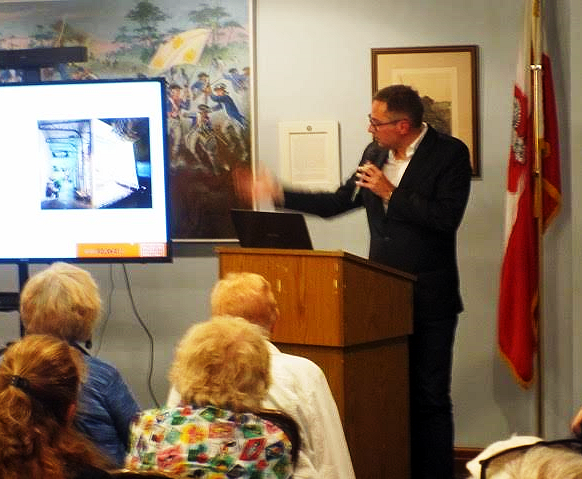
Details of the work at the Emigration Museum in Gdynia, Poland were given by its Deputy Director Sebastian Tyrakowski (accompanied by Dr. Rafał Kaczyński, Research Officer). The Emigration Museum of Gdynia was opened in 2015. It tells the story of the emigration of three and a half million Polish people to new lives in foreign lands.
The site of the museum in Gdynia is what had once been a 1933 built terminal for ocean liners. Destroyed during the Second World War, its rebuild started in 2012. To help frame the strong emotion that attaches to this center of Polish emigration, the building is filled with Polish patriotic symbols.
The first major push for Polish emigration started after the failed November Uprising (1830-1831) that began with the Cadet’s Revolt of 1830. The museum tells the story of this uprising and the resulting migration of people from rural areas to cities and abroad. To help personalize these events, one family’s experience is told in detail. The trauma a family goes through in leaving its home, family and traditional way of life behind is portrayed. One of those stories covers a family leaving its cottage in Galicia, embarking on a crowded ship to New York’s Ellis Island, and later moving on to Chicago.
Causes of this emigration, from the personal, political, economic, and threat of war, are told. Included is the story of “Brazilian Fever,” where tens of thousands of Poles left for Brazil, in search of free land and opportunities, only to discover jungle, tropical diseases, and a world they did not expect. Many of those who tried Brazil, later went on to the U.S. and Canada.
The Museum contains core and temporary exhibits. It also serves as home for cultural, educational and historic projects, and provides a venue for musical events, plays, lectures, conferences, and workshops. Finally, it hosts a section on oral history and publishes its own scientific journal. Emigration Museum of Gdynia, stands as a lasting link and symbol of Poland’s connection to World Polonia.
September 2018 events
Upcoming events for September 2018:
Thursday, September 6, 2018 6:30 P.M. in Polish Center of Wisconsin, Veterans Room
Polish/Kaszube Emigration and Immigration to Milwaukee
“One Story with Three Strains”
You are cordially invited to attend this lecture to be held in the Veterans Room of the Polish Center of Wisconsin. This event is free and open to the public.
Special attention will be paid to the Jones Island Kaszube settlement of fishermen who arrived from the Hel Peninsula in the Gdansk region of Poland beginning in the 1870’s. We will also celebrate the 150th anniversary of St. Stanislaus Bishop and Martyr Church, one of the oldest Polish urban churches in the United States. And lastly, the audience will be treated to a special discussion by the Deputy Director of the recently opened Emigration Museum in Gdynia, Poland, who will focus on its goals, programs and future projects.
Moderator: Dr. Angela Pienkos, Educator, Past President of the Polish American Historical Association, and Past Executive Director of the Polish Center of Wisconsin.
Our Distinguished Panel of Speakers Includes:
Prof. Anne Gurnack, Professor Emerita (Political Science), University of Wisconsin Parkside;
Abbe George Baird, Administrator St. Stanislaus Church of Milwaukee;
Sebastian Tyrakowski, Deputy Director of the Emigration Museum in Gdynia Poland.
Two articles worth reading before the discussion:
“Jones Island Fishing Village, 1898” by Jeff Beutner (2016)
“The story behind Kaszube’s Park: Milwaukee’s smallest, strangest piece of public land“
by Tyler Maas (2017)
September 7-9 at Loyola University Chicago
75th Anniversary of Polish American Historical Association (PAHA)
The program, registration materials and other information about the 3-day conference celebrating PAHA’s history and achievements are available on the PAHA website, PAHA NewsBlog and the letter from PAHA President, prof. Dr. Anna Mazurkiewicz. We remember her from “The Story of Polish and East European Exiles in the United States After World War II” she told the members of PAC-Wisconsin Division and other guests of Polish Center of Wisconsin in November 2017.
2018 Polish Fest Report

2018 POLISH FEST
The annual celebration of Polish heritage
The 37th edition of the Polish Fest took place this year on June 15, 16 and 17. Hosted again on the Summerfest grounds near Milwaukee’s lakefront, the largest Polish Festival on the American soil featured Polish folk dances, lively music, displays of Polish arts and crafts, traditional Polish foods, cooking demonstrations, fireworks, a colorful selection of Polish-themed souvenirs and a variety of educational programs. Some of the young attendees had also a chance to channel their competitive streak during the Polish Fest Pageants and the Chopin Youth Piano Competition.
photo gallery
In contrast to the 2017 Polish Fest accenting the Tadeusz Kościuszko bicentennial, the focus of educational events this year was the 100th anniversary of Poland’s Independence. At the Speakers Forum, Donald Pienkos (professor emeritus of political science, UW-Milwaukee) and Neal Pease (professor of history, UW-Milwaukee) gave several passionate presentations recounting the main facets and protagonists of the events leading to the rebirth of Polish state in 1918.
Another highlight of the Poland’s centennial theme was the Women of Independence exhibit illuminating the frequently overlooked fact that just two weeks after the declaration of Independence, Polish women gained full voting rights (read more about this event in our January 2018 post describing all the people, organization and events celebrated in Poland in 2018). The exhibit was prepared by the Poland’s Ministry of Foreign Affairs and displayed on the fest grounds courtesy of Polanki, The Polish Women’s Cultural Club from Milwaukee.
As usual, the Polish American Congress – Wisconsin Division hosted a booth displaying informational materials about its activities. In addition to learning about programs like Wisconsin Study in Poland, visitors had also a chance to pick up the Centennial of Poland’s Rebirth leaflet summarizing the key events leading to Poland regaining its sovereignty in 1918 and the newly revised booklet Do you know Poland? (both available on this page for download).
Several PAC members generously volunteered to share their knowledge about Polish culture and our organization. Our big thanks go to Karen Bauza, Rita Dow, Majka Drewitz, Camille Faherty, Judith Free, Jerzy Pasko, David Rydzewski, Nancy Staats, Derek Zarzeczny, Thomas Zarzeczny and Krystyna Zuzanski. To see your smiling face in the volunteer column next year, sign up for the 2019 Polish Fest roster.
Other presenters in the Speakers Forum included Helena Pycior (professor of history, emerita, UW-Milwaukee) discussing the milestone years of Marie Skłodowska-Curie, historian John Gurda highlighting the role of Polish workers in the Eight-Hour Movement of 1886, and columnist Steven Szabados offering information useful in genealogical research. And all those 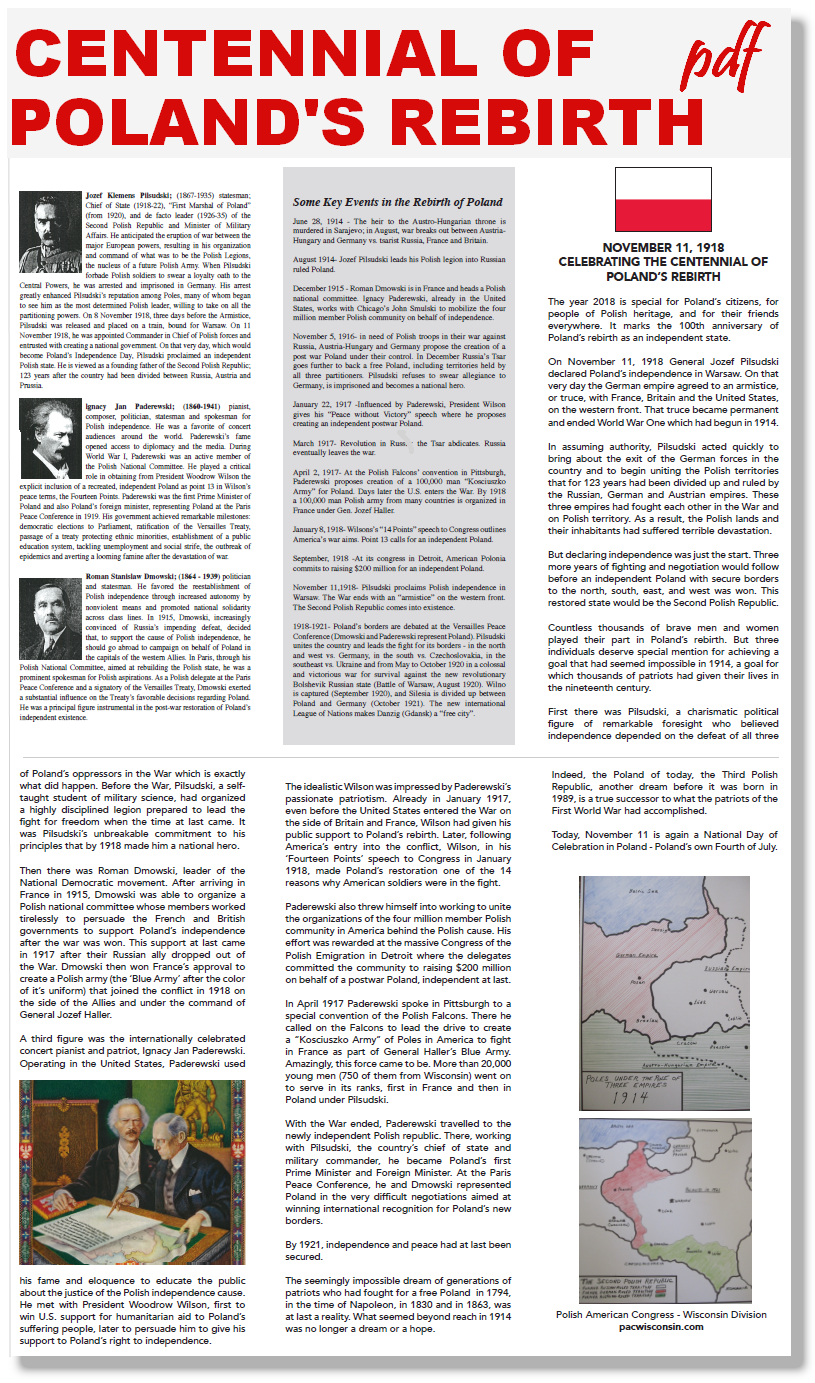 interested in finding their ancestors could examine their options and even get some immediate help from the Polish Genealogical Society of America and Milwaukee County Genealogical Society. The booths of these two groups were located in the “Polish Organizations” tent, where visitors could also learn about activities of many other associations serving the needs of Polish communities the Milwaukee area.
There were also some opportunities to learn some basics of Polish language and enjoy videos and colorful drawings showing the beauty of Poland – all courtesy of staff and students of the Catholic School of Jan Paul II.
Saturday was a special day for Polish folk dance enthusiasts with non-stop performances on the largest stage of the event. In costumes displaying a kaleidoscopic reaches of colors, the lineup of dance groups included ensembles from Illinois (Wesoly Lud, Whispers and Wici), Michigan (Wawel Polish Dancers), Canada (Polonez Polish Canadian Folk Ensemble ) and Milwaukee’s own Syrena Polish Folk Dance Ensemble. [A group of musically gifted dancers of Syrena group performed also folk music on the festival walkways.] The warmest applause, however, went to the young dancers of Polish Highlander Ensemble “Tatry” (see the video box to the left) arriving straight from the Podhale region in Poland. As usual, the spectacular folk dance marathon ended with the dazzling Polish Folk Dance Gala hosted by PFDAA (Polish Folk Dance Association of the Americas).
On Sunday morning, the huge dancers’ venue became a gathering place for the catholic faithful. This year’s mass was celebrated by Father Aron Laskiewicz and the chosen charity was the St. Ann Rest Home, a non-profit nursing home operated by Dominican Sisters.
Upcoming 2018 Polish Fest
Short announcement:
Polish violinist, Mateusz Smoczynski, will perform in the North Street Cabaret Madison, WI on June 19th, 6:30pm (Click here for more information)
Mateusz was voted the VIOLINIST OF THE YEAR in the 2017 JAZZ Top survey by the Jazz Forum, an official journal of the European Jazz Federation
2018 POLISH FEST
Highlights of the upcoming celebration
of Polish pride, heritage and tradition
The 37th edition of Polish Fest will take place again on the Summerfest grounds near Milwaukee’s lakefront. Scheduled this year for June 15, 16 and 17, the Polish Fest program includes exuberant performances of folk dance groups, polka music played continuously on several stages, variety of traditional Polish foods as well as sampling of Polish spirits. The youngest participants might enjoy many age-appropriate performances and contests such as the Chopin Youth Piano Competition and pageants. And everybody will have a chance to pick up some Polish souvenirs and learn new skills by watching folk-artists at work and Polish cooking demonstrations. The Speakers Forum will also provide opportunities to learn more about Polish history & language and get insights useful to all curious about their ancestry (see the listing below).
photo gallery
While the 2017 Polish Fest featured many accents linked to the bicentennial of Tadeusz Kościuszko, some events of the 2018 Polish Fest will highlight the 100th anniversary of Poland’s Independence. Among them expect to see the exhibit of Polish architecture from years 1918-1939 – courtesy of Poland’s Ministry of Foreign Affairs.
The Polish American Congress – Wisconsin Division has prepared for this jubilee year the brochure Centennial of Poland’s Rebirth summarizing the key events leading to Poland regaining its sovereignty in 1918 and their prime movers. The printed copy of this leaflet will be available in the PAC-Wisconsin booth along with a variety of other printed materials promoting the knowledge about Poland and our organization. These materials will include also the newly revised brochure Do you know Poland?
Here is the lineup of main events in the Speakers Forum:
Finding Babcia’s Grandma – From Where Did Your Polish Ancestors Leave?
Steve Szabados, Genealogy Columnist for the Polish American Journal and Author
Friday June 15th, 2:00-3:00 p.m.
100 Years of US-Polish Relations, 1918-2018
Dr. Neal Pease, Professor of History (UW-Milwaukee)
Friday June 15th, 4:00-5:00 p.m.
Let’s Remember Marie Skłodowska Curie! What a Century of Anniversary Celebrations of Her Milestone Years (1867,1898,1903,1911) Tell Us
Dr. Helena Pycior, Professor of History, Emerita (UW-Milwaukee)
Saturday June 16th, 1:30-2:30 p.m.
A Look Back: The 100th Anniversary of Poland’s Rebirth and Its Significance
(panel discussion)
Dr. Donald Pienkos, Professor of Political Science, Emeritus (UW-Milwaukee)
Dr. Neal Pease, Professor of History (UW-Milwaukee)
Saturday June 16th, 2:30-3:30 p.m.
Poland’s Rebirth: Three Who Made It Happen:
A Soldier, a Politician, and a Virtuous Pianist
Dr. Donald Pienkos, Professor of Political Science, Emeritus (UW-Milwaukee)
Saturday June 16th, 3:30-4:30 p.m.
The Struggle for Independence in America:
Polish Workers and the Eight-Hour Movement of 1886
John Gurda, Milwaukee-born writer and historian
Sunday June 17th, 4:30-5:30 p.m.
Archived Posts
- 2025 Polish Independence Day / Veterans Day invitation
- 2025 Millennium Lecture
- 2025 Millennium Concert
- 2025 Wianki Festival
- 2025 Remembering Katyń Massacre (1940) and Smolensk Tragedy (2010)
- 2024 Independence Day and Veteran Day invitation
- 80th Anniversary of the 1944 Warsaw Uprising
- 2024 Wianki Festival
- 2024 Polish Constitution Day in Wisconsin
- 2023 Merry Christmas
- 2023 Lighting the Light of Freedom on Dec 13 at 7:30pm
- Independence Day and Veteran Day invitation
- 2023 Wianki Festival
- 2023 May 3rd Constitution Day Celebration
- 2023 Lecture on Polish Borders by Prof. Don Pienkos
- 2023 REMEMBER THIS: Jan Karski movie premieres on PBS Wisconsin
- 2023 Upcoming lectures in the Polish Center of Wisconsin
- 2022 Polish National Independence Day
- 2022 Independence and Veteran Day Luncheon (invitation)
- 2022 Wianki, Polish Celebration of Noc Świętojańska (St. John’s Night)
- Celebrating Constitution of May 3, 1791 in Polish Center of Wisconsin
- 2022 Polish Constitution Day, Polish Flag Day and the Day of Polonia
- 2022 March Bulletin
- 2022 Polonia For Ukraine Donations
- 2022 Polish American Congress Condemns Russian Invasion of Ukraine
- 2022 PAC-WI State Division Letters to WI Senators and Representatives
- 2021 Polish Christmas Carols
- 2021 Panel Discussion: Martial Law in Poland 1981-1983 (REPORT)
- 2021 Panel Discussion: Martial Law. Poland 1981-1983 (invitation)
- 2021 Solidarity: Underground Publishing and Martial Law 1981-1983
- 2021 Polish Independence Day and Veterans Day
- 2021 Polish Independence Day and Veterans Day Luncheon
- 2021 Prof. Pienkos lecture: Polish Vote in US Presidential Elections
- 2021 POLISH HERITAGE MONTH EVENTS
- 2021 “Freedom” Monument Unveiled in Stevens Point, Wisconsin
- 2021 PCW Picnic and Fair
- 2021 Remembering Września Children Strikes (1901-1903)
- 2021 May 3 Constitution Day
- 2021 DYKP Contest Winners and Answers
- 2021 Casimir Pulaski Day
- 2021 DYKP CONTEST EXTENDED and CASIMIR PULASKI DAY
- 2021 February announcements
- 2021 Polish Ministry of Education and Science oficials visit Wisconsin
- 2021 DYKP Contest, KF Gallery and Dr. Pease lectures
- 2020 Help Enact Resolution commemorating the 80th Anniversary of the Katyn Massacre
- 2020 Independence And Veterans Day
- 2020 Remembering Paderewski
- 2020 POLISH HERITAGE MONTH
- 2020 Solidarity born 40 years ago
- 2020 Battle of Warsaw Centenary
- 2020 The Warsaw Rising Remembrance
- 2020 June/July News: Polish Elections, Polish Films Online and more
- 2020 Poland: Virtual Tours
- Centennial of John Paul II’s Birth
- 2020 Celebrating Polish Flag, Polonia and Constitution of May 3rd
- 2020 Polish Easter Traditions
- 2020 Census and Annual Election
- Flavor of Poland (Update 3)
- 2020 Copernicus, Banach & Enigma talk
| M | T | W | T | F | S | S |
|---|---|---|---|---|---|---|
| « Oct | ||||||
| 1 | 2 | 3 | 4 | 5 | ||
| 6 | 7 | 8 | 9 | 10 | 11 | 12 |
| 13 | 14 | 15 | 16 | 17 | 18 | 19 |
| 20 | 21 | 22 | 23 | 24 | 25 | 26 |
| 27 | 28 | 29 | 30 | |||