
2021 Panel Discussion: Martial Law in Poland 1981-1983 (REPORT)
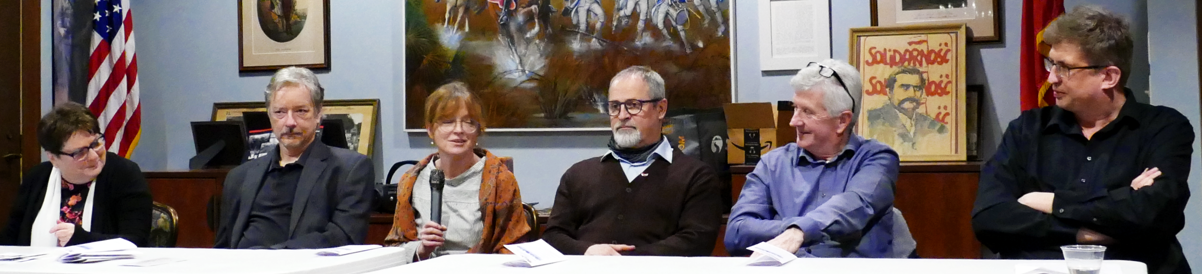
Panelists speaking in the Veterans Room of Polish Center of Wisconsin (from left to right): Irena Frączek (PAC, PHC, event organizer), Andrew Woźniewicz (PAC), Julita Zolnik (PHC), Ryszard Zolnik (PHC), Jacek Franczak, and Szymon Woźniczka (PHC). All panelists were born and residing in Poland at the time. Places they mentioned are marked on the map below.
Photo: Karen Wieckowski.
……………
WE REMEMBER
Panel Discussion
Martial Law in Poland 1981-1983
Irena Frączek reports……
On December 13, 2021, the Polish American Congress – Wisconsin Division (PAC) and Polish Heritage Club Wisconsin-Madison (PHC) co-sponsored a memorable panel discussion held in remembrance of the 40th anniversary of martial law imposed in Poland on December 13, 1981. Prof. Donald Pienkos moderated the event, while Prof. Neal Pease delivered closing remarks. The event was hosted in the beautiful Polish Center of Wisconsin in Franklin.
Speaking first, Irena Frączek began by bringing up the specter of a Russian invasion weighting heavily on the peoples’ minds in 1981. She lived close to the Warsaw’s Okęcie airport and on some occasions, the noise of planes landing and taking off all nights long kept her fearful of what the morning news would bring. She was awake at midnight on December 13, 1981, when her radio went silent. Little did she know that at that time, the police and military was seizing all TV and radio stations, including the Polish TV headquarters, located just two blocks away on Woronicza Street. From there, General Jaruzelski’ speech announcing martial law was continually broadcast since 6 am. Half asleep, Irena heard it echoing through the neighborhood, but its actual content became clear only after an in-law came to talk over the implications of the shocking news.
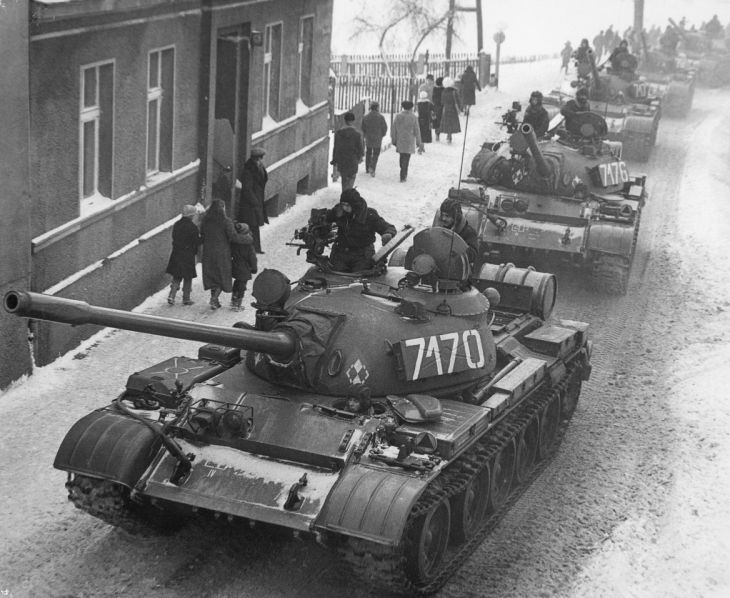
The Wikimedia image above shows Polish T-55 tanks entering Zbąszyń, a small town near the Szczecin-Warsaw route (see the map below).
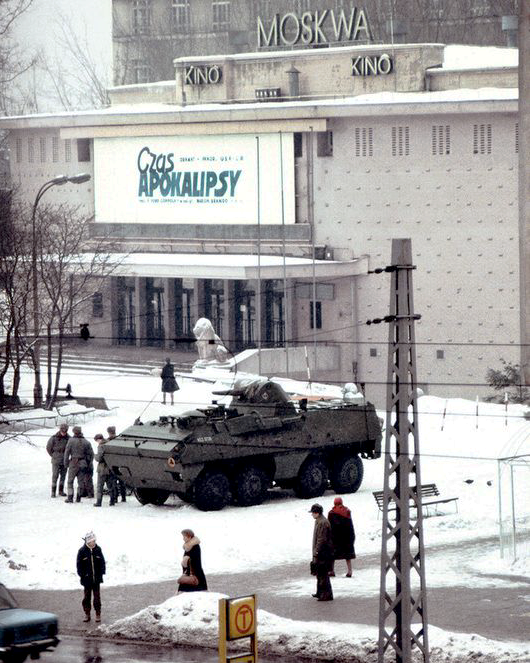
The symbolism of armored carrier parked in front of the movie theater called Moscow (Moskwa) playing Coppola’s “Apocalypse Now” did not escape attention of Warsaw’s inhabitants. Preserved for posterity by the famed Chris Niedenthal, the shut – taken despite the ban on photographing – is one of the most iconic images of martial law. Source: DigitalCameraPolska
Not knowing about some arrests that hit close to home, the travel restriction and cut off phone lines became the main concern because her husband was expected to return from Western Europe on that Sunday. As it turned out later, he entered Poland just minutes before borders were sealed at midnight and defying the intercity traffic ban, he embarked on a harrowing backroads journey from Szczecin to Warsaw. Some tanks encountered on the road would push his car into the ditch, then sympathetic crews from other tanks would pull him out, also providing gasoline that by decree was unavailable to civilians. About three days later, he reached Warsaw only to learn with the rest of us about the massacre that killed 9 miners during the bloody pacification of the strike in coal-mine “Wujek.”
For Andrew Woźniewicz, martial law begun late at night on December 12th with an ominous sound of tanks rolling down the street. He looked through the window and what a relief: they were not marked with Soviet stars. Reactions of the world intercepted on the short-wave radio confirmed that this wasn’t a dreaded Russian intervention. With time, it became clear that the swift crackdown on 320 cadets striking in Warsaw’s Firefighters Academy just ten days earlier was a dry run for the planned martial law. Andrew witnessed the entire operation from a streetcar stuck in the stopped traffic. No blood was shed but the full-blown ZOMO (special units of riot police) assault, aided by the helicopter landing on the roof and the military cordoning the academy off, was the largest use of force since the birth of Solidarity in August 1980.
Another line in Andrew’s story was his own participation in strikes engulfing most of Polish universities in November 1981. As a freshmen med student, he joined a sit-in protest at the Medical University of Warsaw, where he met Fr. Jerzy Popiełuszko on multiple occasions. Fr. Jerzy became a major force in dismantling the communist regime thanks to his staunch opposition to the repressive communist system and extraordinary motivational powers. His unwavering espousal of peaceful resistance helped to shape the strategies of the Solidarity movement but failed to protect his own life. He was assassinated by Security Police (Służba Bezpieczeństwa, SB) on October 19, 1983.
The story of Jacek Franczak began at his
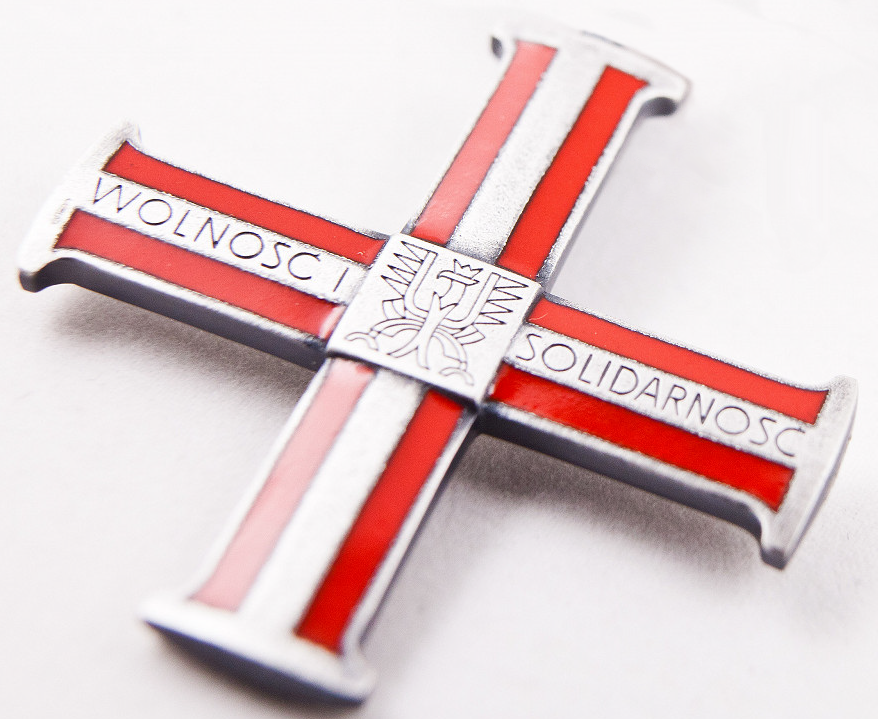
For his contribution to democratic opposition, Jacek Franczak was awarded the Cross of Freedom and Solidarity by President Andrzej Duda on Nov. 11, 2021.
The buses safely passed the cordons surrounding the plant and students joined thousands of strikers inside. One of the most important tasks of the AGH newcomers was assisting the production of printed materials and distributing critical information to the communication teams. Pacification of the strike began in the evening of December 16, 1981. Jacek avoided arrest on that night because two days earlier, he and his close friend were asked to “jump the fence” and collect some critical information and items on outside. He then helped to create a new underground organization ARS (Academical Self-Defense Movement). In short order, the ARS started printing a weekly newspaper “So Long as We Live” (Póki my żyjemy) providing Kraków’s students with information free of governmental control. He was involved also in printing and distributing “The Lesser Poland Chronicle” (Kronika Małopolska) published between 1982-1989 by the Solidarity forced underground.
In the meantime, Ryszard Zolnik was one of those highschoolers who enjoyed no school days at the first weeks of martial law. Yet soon, the loss of civil liberties, and particularly the freedom of movement, became unbearable. That’s why in June 1982, Ryszard showed up at the street demonstration organized in his hometown Dzierżoniów (Lower Silesia). Of course, all public gatherings were still illegal, and Ryszard got arrested along with many other participants. They were thrown into the trademark blue police vans called “
Like all his fellow arrestees, Ryszard was found guilty by special expedited court. The official penalty was a hefty fine that his parents had to pay before taking him home. But still in Nowa Ruda jail, they were all forced through the infamous “ścieżka zdrowia” (a painfully ironic use of the term “fitness trail”), i.e., the gauntlet of police beating the inmates with batons. The severity of beating was somewhat reduced for the younger “offenders,” but they saw the hard pummeling that knocked down an older prisoner. After returning to school, Ryszard was publicly reprimanded in front of the entire school for his “shameful behavior.”
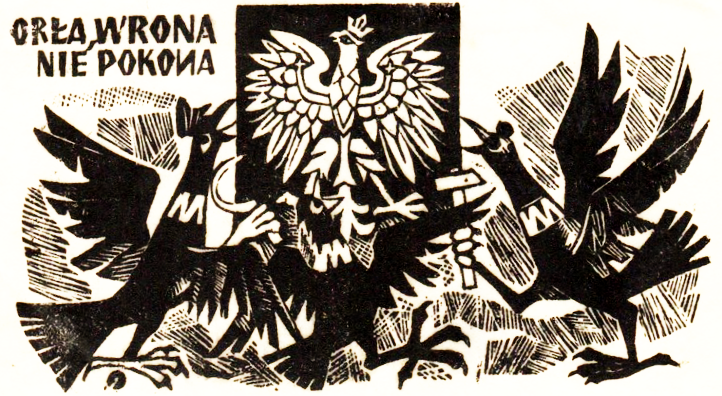
For millions of ordinary Poles, humor became an outlet for venting anguish and resentment, as well as a form of non-violent retaliation against the oppressors. Jokes, epigrams, satires spread by the word of mouth, underground-printed materials or inscriptions on the walls. One of the best known puns was “The crow shall not defeat the eagle” (Orła wrona nie pokona), seen in the image above. The eagle epitomizes the Polish nation, while the crow (wrona in Polish) stands for the junta known by its acronym WRON (Wojskowa Rada Ocalenia Narodowego, i.e. the Military Council of National Salvation).
Image design: Jan Stańda. Source: Allegro website.
The Orła wrona nie pokona phrase weaves through the song recorded by the group DePress in Norway. Presented on the backdrop of martial law images, the song explains how the crow hatched out from a “red” egg and ends with another popular phrase “The crow will perish” (Wrona skona).
A spark of humor flashed in a story of Szymon Woźniczka from Zakopane. He was just 13 when martial law went into effect, but his understanding of the ongoing events was substantial. What helped was a family including avid readers of the underground publications and regular listeners to the Radio Free Europe and Voice of America. Another formative influence was Wojciech Niedziałek, a family friend with the past in Home Army (AK), and a history of being discriminated against and persecuted for his anticommunist views and activities. An additional inspiration for the incident shared on the panel came from the “memes” and jokes spreading like fire through the nation.
When schools re-opened in January 1982, Szymon and several friends expressed their disapproval of martial law and Solidarity dissolution by plastering school walls with handmade posters poking fun at the repressive junta and some of the most despised members of the communist party. Police was called in when one of the teachers recognized the handwriting styles. After landing in the police station, the boys were treated to a milder version of “
A few snippets of hardships in everyday life were interwoven in the story of Julita Zolnik from Warsaw. Also 13 at the time, she was old enough to remember empty stores and many other “unpleasantries” of the economic system on the verge of collapse. Martial law exacerbated these woes and increased the associated risks. For example, her father venturing to the countryside to replenish the dwindling food supplies risked jail time and/or fines for “illegal commerce” and/or ignoring bans on civilian traffic.
Other memories included tanks on the street, protests breaking up in the clouds of tear gas and ruthless beating of demonstrators chased off the streets by ZOMO. “They looked possessed” – said Julita describing a scene she witnessed in the courtyard of her apartment building. This observation aligns with rampant speculations that ZOMO thugs were being drugged before the action. Faced with those harsh realities, many young people chose to wear resistors (devices controlling current in electronic devices) on their clothes. They were tiny but big enough to efficiently conveyed the message: “We resist!” School officials noticed them too and soon, Julita and her classmates, one by one, were called to the principal’s office and subjected to threatening remarks that such “behavior” was sure to destroy their future by making them ineligible for admission to universities or ruining their parents’ careers.
The general discussion that followed these recollections began with acknowledging the essential role of church in those events. For individuals, even the non-religious ones, church provided places to gather, regain hope and get the otherwise unavailable information. For Solidarity and other independent organizations, church was the only option because the government controlled all other venues and channels of communication. Those organizations kept producing torrents of information that people could trust – in contrast to “fake news” peddled in the government-controlled media (known also as “mass disinformation”). In terms of numbers, Prof. Donald Pienkos recalled a report that one year, the regime confiscated around 600,000 copies of underground publications. But this was only a fraction of the huge, never intercepted totals and those served as a true lifeline for the oppressed nation because – as one panelist remarked – the need for truthful information is next only to the need for food keeping us alive.
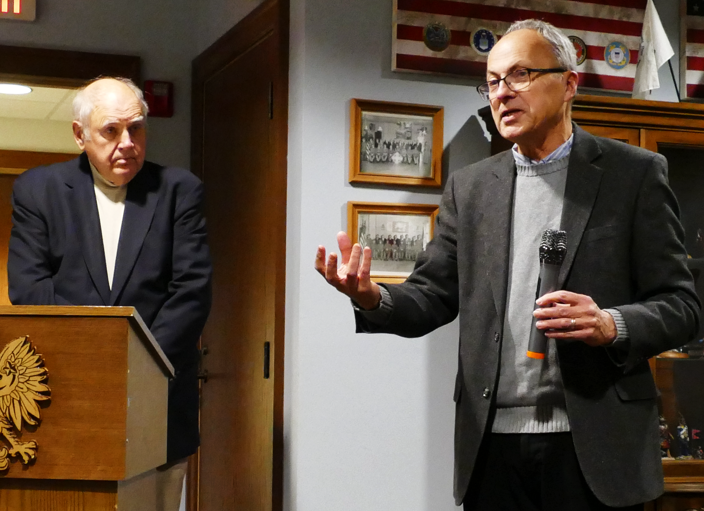
From left to right: Professors Donald Pienkos and Neal Pease, both emeritus faculty of the University of Wisconsin-Milwaukee
Photo: Karen Wieckowski.
The complicated issue of bringing the perpetrators to justice dominated the rest of discussion. In some cases, the main culprits remain unknown. For example, the three murderers of Fr. Popiełuszko and their immediate superior were tried and convicted, but who gave them the orders at the upper echelons of secret police has not been identified. Moreover, assessing culpability is often difficult – especially with on a personal level and with the passage of time. Finally, some perpetrators offered convincing justifications for their actions. The case in point was Gen. Jaruzelski himself, claiming to the end of his days that imposition of martial law was necessary to avoid the bloodshed and destruction inevitably coming with the widely feared intervention of Russian and/or the Warsaw Pact forces. The concept of “thick line” (gruba kreska) was also thrown into the mix. Articulated in the aftermath of the Round Table talks in 1989, the idea was to draw a line past which the sins of previous regime are forgiven, and instead, focus on extracting Poland from its plight. However, the resulting policy of de facto non-punishment became a source of emotional disagreements that continue until today.
In conclusion of this memorable evening, Prof. Neal Pease summarized martial law from the historian’s perspective. He briefly revisited the issue of whether Gen. Jaruzelski was a criminal or a patriot. The answer is unclear because judging by the opinion polls taken in Poland, the narrative of choosing the ”lesser evil” – whether Soviet invasion was likely or not – seems to resonate with general public. The historical context for further discussion was introduced with a paraphrased quip coined in the late 1980s: “In Czechoslovakia, the downfall of communism took 10 days, in East Germany – 10 weeks, in Hungary – 10 months, in Poland – 10 years.” Martial law was a part of those 10 years, and crackdown on Solidarity was its immediate target. But in fact, the crisis it aimed to redress predated those 10 years and the real issue was not Solidarity but the growing “incorrectitude” of the system. Resorting to the military rule appeared to be a desperate attempt to salvage the irremediable system and that’s why – despite exceptionally efficient planning and execution – it ultimately failed.
Last edits on February 1, 2022……
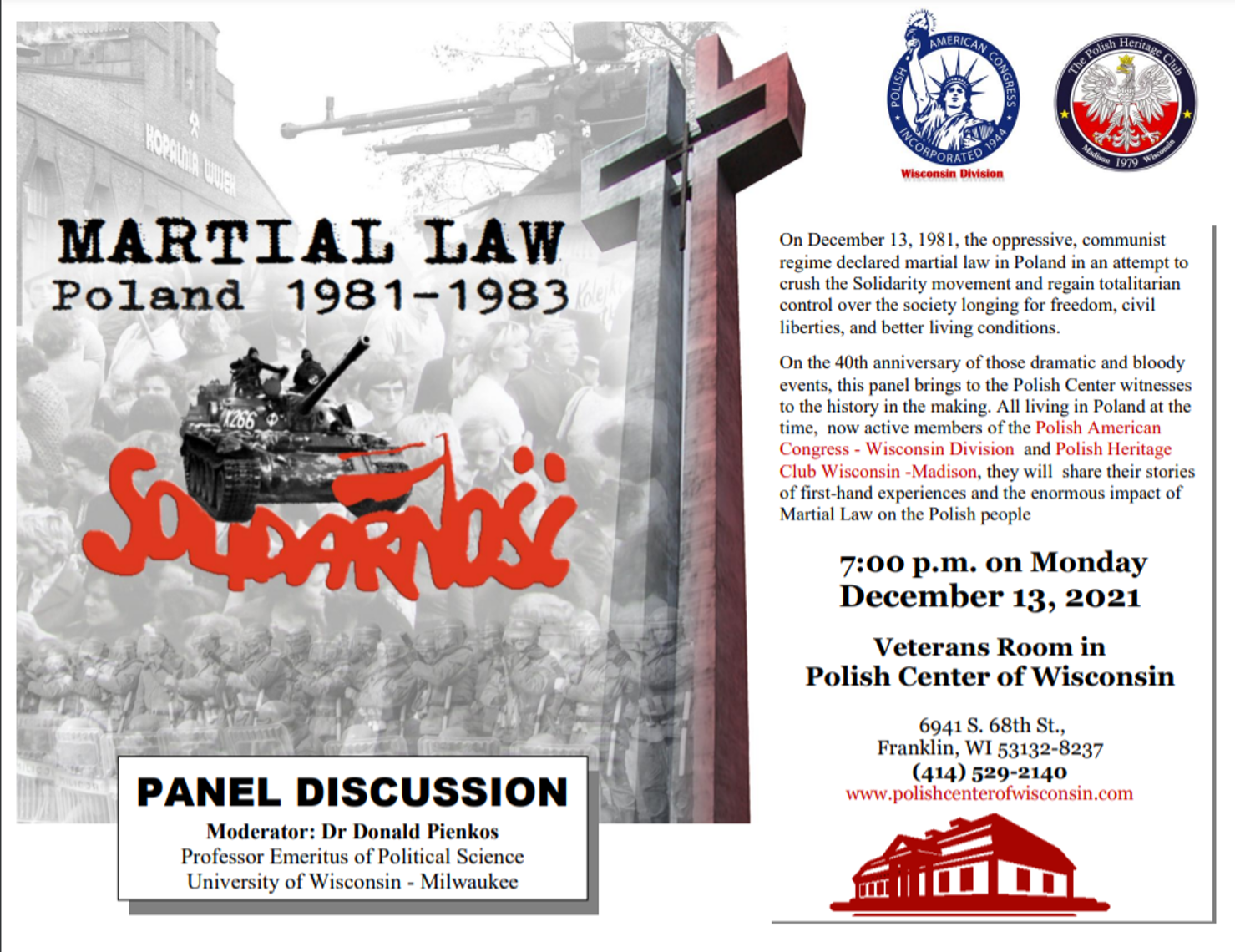
2021 Panel Discussion: Martial Law. Poland 1981-1983 (invitation)
Polish American Congress invites all to the panel discussion held in remembrance of martial law declared in Poland on December 13, 1981.
If unable to join us at the Polish Center of Wisconsin, we encourage everyone to kindle the Light of Freedom on Monday, December 13th 2021 exactly at 7.30 pm
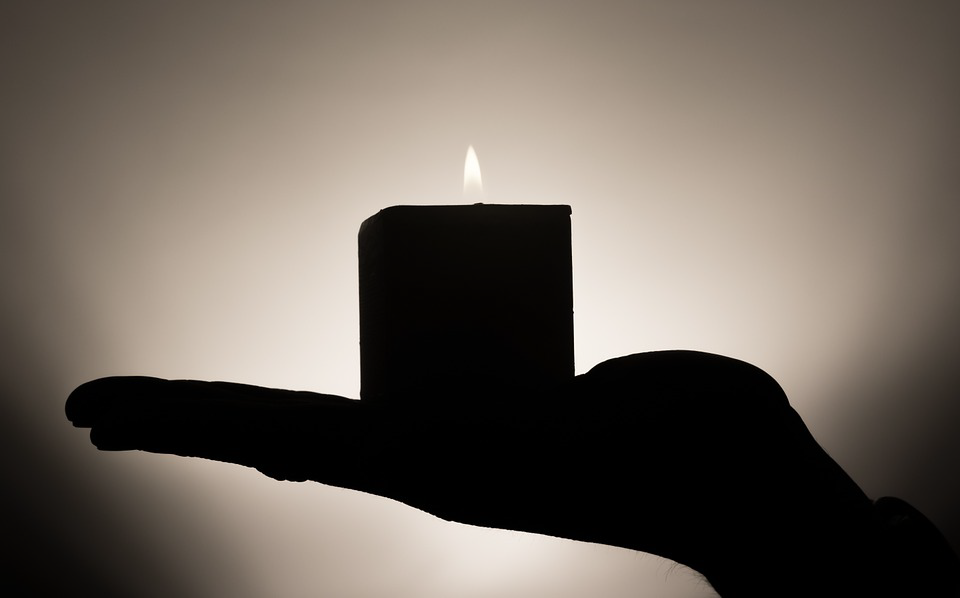
Forty years ago, the Polish Pope John Paul II lit a candle in a Vatican window in solidarity with his homeland, the then US President Ronald Reagan placed a lighted candle in a White House window and called upon the Americans for a similar gesture of unity with the victims of martial law. …In all, millions of Americans placed candles in their windows.
On December 13, 1981, the oppressive, communist regime declared martial law in Poland in an attempt to crush the Solidarity movement and regain totalitarian control over the society longing for freedom, civil liberties, and better living conditions.
On the 40th anniversary of those dramatic and bloody events, this panel brings to the Polish Center witnesses to the history in the making. All living in Poland at the time, now active members of the Polish American Congress – Wisconsin Division and Polish Heritage Club Wisconsin -Madison, they will share their stories of first-hand experiences and the enormous impact of Martial Law on the Polish people.
This event is free and open to the public
► Map of Location ◄ …………..► Printable Flyer◄
For additional information, please contact
David Rydzewski at (414) 964-2447 or david.rydzewski@att.net
2021 Solidarity: Underground Publishing and Martial Law 1981-1983

REMEMBERING SOLIDARITY 1980-1981
Through the Lens of Independent Publishing
& Martial Law Imposed on December 13, 1981
August 31, 1980, marked the 40th anniversary of the birth of Polish Solidarity. On that day in 1980, the landmark August Agreement was signed between then the communist government of Poland and the Interfactory Strike Committee (Międzyzakładowy Komitet Strajkowy, MKS) formed on the third day of strike that erupted in Gdańsk shipyard on August 14, 1980. About 16,000 shipyard employees joined the protest but within a couple of weeks, around 1 million workers all over Poland went on strike as well. In this way, one of the biggest strikes ever ensued and the MKS became an alliance of numerous independent organizations. When signing the August Agreement on August 31, 1980, it represented about 3 million workers from nearly 3,500 enterprises. The rest of Poland was holding breath in hope that this rise will end in victory rather than a bloody finale like other strikes before.
For more about Solidarity movement, visit Professor D. Pienkos’ story
The Amazing Story of Solidarity Begins – 40 Years Ago
The firing of Anna Walentynowicz for her illegal trade union activity was a spark that ignited the 1980 strike in the Gdańsk shipyard but root causes run much deeper. Of course there were hikes of food prices and shortages of nearly everything – the ominous signs of economy on the verge of collapse. Living in Poland until 1983, I will never forget the dread of food rationing, the humiliation of standing in endless lines, or the misery of waiting 16-20 years for the already paid off apartment. Available in abundance, however, was the devious misinformation and stupefying propaganda spewed by the government controlled media. For me personally, a symbolic image of that reality was a neighborhood store with empty shelves and a few bottles of vinegar sitting on the counter next to a big pile of the state-run newspaper.
Striking workers wanted to participate in the process of taking the country out of the crisis and this desire was articulated as part o the famous list of 21 demands issued on August 17, 1980 and posted on the shipyard’s gate. After the government signed off on these demands on August 31, 2020, the nationwide labor union Solidarity (Solidarność) was registered on September 24, 1980. Amid the euphoria sweeping the country, Solidarity kept growing fast with students, intellectuals, farmers, and professionals joining its ranks. In September 1981, it had about 10 million members (in a country with a total population of 35.5 million). Moreover, surrounding its trade union core, Solidarity became a de facto social movement and one of its most important imprints was exerted in the area of what became available for people to read.
The all-pervasive euphoria on display during meeting with leaders of the strike in the Gdańsk shipyard (Panel from the Solidarity exhibit, brought to Madison in 2012 and co-sponsored by PHC-Madison)
The MKS recognized the importance of access to reliable sources of information by placing the freedom of speech, the press and publication as No. 3 on the famous list of 21 demands issued on August 17, 1980. To be clear, the Polish Constitution of 1952, then in effect, already guaranteed the freedom of speech and the press, along with other rights observed in civilized societies. Yet, the Polish United Workers’ Party (PZPR) ruled the country based on its own statutes – constitution was relegated to the role of a legitimacy smokescreen. The cornerstone of the PZPR rule was its strict control over information needed to subdue people into submission. Relentless censorship was the rule of the day, creating a market for the underground publishing – and in this area, Poland had strong traditions going back about 200 years.
Books and periodicals published underground were known as bibuła (literally in Polish, a blotting paper) or drugi obieg (second circulation), where first circulation meant censored publications. In terms of volume, the British Library estimates that about 3,000-4,000 independent periodicals and over 6,000 books and pamphlets were published between 1976 and 1990. The main organizers of the underground publishing before Solidarity was born included the Movement for Defense of Human and Civic Rights (ROPCiO) and Workers’ Defense Committee (KOR). It is thanks to their activities – such as helping to smuggle printing supplies from abroad or obtain them illegally from the official publishing houses – that the underground publishers of various sizes could flourish.
Entering the Solidarity era, the volume of independent publications skyrocketed, while their profile changed from the predominantly book-oriented to the one focused on periodicals and other more or less serial news publications produced in nearly every corner of Poland. Although rarely prosecuted, vast majority of them was still published illegally or semi-legally – with help of printing supplies flowing in from sympathetic trade unions in the West. Circulation varied from hundreds in smaller workplaces to 30,000 for the newsletter published in the Gdańsk shipyard during the strike.
Only two periodicals received the governmental consent. The weekly Unity (Jedność) was published in Szczecin until December 1981, with circulation up to 150,000 for some special issues. On the other hand, the Solidarity Weekly (Tygodnik Solidarność, see image near the title), led by Tadeusz Mazowiecki (later the prime minister of Poland, 1989-1990), reached circulation of 500,000. These numbers could easily be higher but the governmental approval came at the price. One was that paper rationing was limiting the number of printed copies. Another price to pay was that despite a significant leeway, both magazines were still subjected to censorship.
The lively publishing activities came to a screeching halt when the next first secretary, General Wojciech Jaruzelski – unable to fix the economy and prevent further disintegration of the communist system – declared the martial law on Sunday, December 13, 1981. In the pitiless crackdown on the Solidarity movement, thousands of tanks and armored combat vehicles hit the roads, along with over 100,000 soldiers and state police unleashed to squash any forms of resistance. Solidarity was stripped of its legal status. Over 10,000 people (primarily Solidarity members) ended locked up in the internments camps. The independent printing equipment was seized, radio and TV stations besieged, and telephone lines cut off under the pretext of preventing the “spread of misinformation.”
Riot troops called ZOMO (Motorized Reserve of the Citizens’ Militia) and military ready to attack the workers striking in the Gdańsk shipyard on December 16, 1981 (Panel from the Solidarity exhibit, brought to Madison in 2012 and co-sponsored by PHC-Madison)
As surprising as it may seem, the damage to the publishing base proved to not last long, and at that time my encounters with Solidarity publications became more personal. Until the Solidarity regrouped and underground publishing resumed, humble typewriters were used to patch up the information void. Thousands of anonymous volunteers – including myself – painstakingly re-typed the information bulletins in as many carbon copies as typewriters would handle.
Of course, getting caught copying, or even possessing these materials, was fraught with risk of harsh punishments. I came dangerously close to finding out what they would be when one day the house where I was doing the typing was raided and searched. Everything happened so quickly that I managed only to shove the typewriter into the nearest closet (by the way, totally empty, not even one piece of cloth to use as a cover). There was also no time to remove the paper load, the incontrovertible evidence of my “misdeed.” I was mortified when three soldiers and three policemen entered the room because the typewriter’s discovery was inevitable.
Luckily for me, the gossips circulating about some soldiers having courage to side with the people proved true. The soldier ordered to check the closet started opening its sliding door, stopped moving it as soon as he saw what’s inside, gave me a long gaze, and then simply announced: “Clear!” I will never know why he did what he did but as it turned out later, one of my in-laws was the actual reason for the ride. A lawyer for years providing his services in defense of arrested demonstrators, he went into hiding after avoiding arrest on December 13 by a sheer stroke of luck.
My second brush with danger related to the possession of illegal printed matter occurred in September 1983, just few weeks after the martial law was officially lifted on July 22, 1983 (although in one form or another it persisted for next 2-3 years). Heading for the United States, I arrived at the Okęcie Airport in Warsaw with a suitcase containing several pounds of underground publications hiding under a layer of scientific papers. The view extending from the airport’s upper gallery was scary. Down below was the main hall converted into a huge check-in area, where custom and security officers tenaciously ploughed through the piles of personal possessions removed from suitcases on the long rows of tables. Yet, I descended down with some irrational hope that somehow, I will make it through. And I did…
Today these materials are a part of the Solidarity Collection, held in the Memorial Library of the University of Wisconsin-Madison – preserving the memory of people working hard and risking their freedom for a just cause.
Irena Frączek
Reprint from the newsletter published by the Polish Heritage Club, Wisconsin Madison
2021 Polish Independence Day and Veterans Day
Ted (Tadeusz) Cisek, the veteran granted the PAC-Wisconsin Division honorary membership on November 7, 2021
…
2021 Polish Independence Day
and Veterans Day celebration
Irena Frączek reports……
“From the lessons learned in Poland’s over 100 year history and from the diligence and hard work of its citizens, today it has one of the most vibrant economies in all of Europe. For Polish Americans we can be very proud of that, as we gather together today to honor our heritage, and to recognize Poland’s past, its present, and prayerfully a bright long and successful future.”
With these words, the President of Polish American Congress (PAC) Wisconsin Division, David Rydzewski, concluded his main address delivered at the luncheon held annually since 1979 to celebrate the Polish Independence Day (in Polish, Narodowe Święto Niepodległości) and Veterans Day, both observed officially on November 11th.
The 2021 event will be remembered for its particularly cheerful ambiance, a standing ovation for one of the 2021 honorees and the evident bolstering of ties connecting Polish organizations in Wisconsin. It began with David Rydzewski’s opening remarks and a warm welcome from Steven Chybowski, the President of the Polish Heritage Alliance, an organization managing the Polish Center of Wisconsin (PCW), where the Independence Day luncheons are hosted since 2000.
photo gallery
Over 120 guests attended the event, some arriving from Michigan and Illinois. The list below (in addition to names mentioned throughout the event’s description) provides insight into the variety of organizations visible at the event:
● Kenneth Skowronski, Wisconsin State Representative, 82nd Assembly District;
● Nellie De Baker, State Commander and National Vice Commander of the Polish Legion of American Veterans;
● Roger Radonski, Commander of Post 49, Kobus Molenda Polish Legion of American Veterans;
● James Robaczewski, President of Polish Roman Catholic Union of America, Chicago, IL;
● Teresa Jankowski, Commissioner of Polish National Alliance Dist. 14 Wisconsin;
● Four Past Presidents of the Polish Heritage Club of Madison (Jane Dunn, Ryszard Zolnik, Marge Morgan, Diane Pillsbury) and 2022 President Elect, Ralph Tyksinski;
● Jeff Kuderski, Executive Director of the Polish Heritage Alliance;
● Malgosia Daugherty, President of the Polish Heritage Society of Northeastern Wisconsin;
● Boleslaw Kochanowski, Past President of the Polish Heritage Awareness Society of Central Wisconsin and creator of the sculpture ” For Our Freedom and Yours” unveiled recently in Stevens Point, Wisconsin.
The Invocation given by Father Wayne Jenkins preceded an elegant meal prepared and served under the watchful eyes of Mike Norman and Martha Norman. Soon thereafter, Daniel Klosowski, past Wisconsin State Commander of the Polish Legion of American Veterans, delivered a salute honoring all veterans.
In the last part of the event, the MC Andrew Woźniewicz gave floor to Derek Zarzeczny and Karen Więckowski, who introduced four individuals recognized with special honors on this occasion. Two of them, Frank Czarnecki and Irena Frączek, received the Congressman Clement Zablocki Civic Achievement Award traditionally presented during the luncheon. Both 2021 recipients received also the commemorative plaques from the Wisconsin Assembly and from the US Congress.
The final chord of the event touched many hearts when Ted Cisek and Donald Pienkos, both past recipients of the Zablocki Award, were granted the honorary membership in the Wisconsin Division of Polish American Congress. Accepting the honor for Ted Cisek, who couldn’t attend due to health concerns, were his children Elizabeth Barber and Edward Cisek. Both were visibly moved when the outpouring of appreciation for their father’s achievements and sacrifices turned into the standing ovation. And in terms of specifics, the biographies of all four honorees are quoted below just as they were read to the audience during this truly memorable event.
FRANK CZARNECKI was born in Hamtramck, Michigan, which was a Polish enclave surrounded by Detroit. That put him on track to appreciate and love his Polish heritage. He studied Polish from first grade through twelfth, and then took it for two years in college. Unfortunately, all those classes focused on vocabulary and grammar, not conversation. Frank regrets that he was never been a fluent speaker of Polish.
He knows many of the seasonal songs (Christmas and Easter), Marian songs, songs to St. Joseph and St. Francis, as well as Gorzkie Żale. His Śpiewnik Koscielny is a treasured possession.
Growing up, Franks’s family celebrated Wigilja with the sharing of the oplatek. Groch z kapusta was served (But not a favorite of his). To him it was SO dry. All the kids in the family had some wine. The amount was determined by their age. His mom prepared the usual Easter basket for blessing at church on Holy Saturday.
Frank and his children continue the sharing of the opłatek on Christmas Eve. They sing Christmas carols. He permits himself a chance to sing two or three kolędy.
He has been a member and/or board member of the Polish Heritage Society of Northeast Wisconsin for many years. He enjoys its internal activities (mostly potlucks), and its external activities such as a kiosk at Art Street, Pulaski Polka Days, and Arty Gras.
Besides activities related to his Polish heritage, he also volunteers at Literacy Green Bay (teaching English to immigrants) and drives for Curative Connections which provides inexpensive rides for the elderly and handicapped to appointments, shopping, and other activities.
Frank adds “I have to share one more activity and encourage you, if you are able, to give it serious consideration once the pandemic concerns are over. I went to Poland twice with Global Volunteers – once to Siedlce and the other to Zakopane. Our purpose was to give Poles, who are studying English, an opportunity to practice and interact with native English speakers. It was a wonderful experience. We lived right with the students. On one trip I took a teenage nephew (whose heritage is Danish). He is still in touch with several of our students. He returned to the U.S. and took two years of Polish at UW – Milwaukee. He has been accepted at a Polish university (I want to say Wroclaw) where he intends to get his master’s degree. You do not have to be a teacher to serve in this program. You just have to be a native speaker of English. It’s what you have been doing all your life!.”
Lastly, Frank’s joy in service to others is matched by his joy in learning about and experiencing the world where he has traveled to all seven continents.
Frank, you are a real inspiration to us.
IRENA FRACZEK is a native of Poland and a graduate of the University of Warsaw, where she earned a Master’s degree. Winning a Kosciuszko Foundation Scholarship enabled her to come to the United States and study at the University of Wisconsin-Madison, where she later taught environmental science and participated in the UW’s very first steps in online instruction.
Irena is a member of the Polish Heritage Club Wisconsin-Madison where she runs the club website and participates in activities that expand the club’s outreach and community connections (e.g. bringing the “Auschwitz Exhibit” to the UW-Madison campus or coordinating sponsorship of the “Flavor of Poland” PBS series). The PHC recognized Irena’s special contributions by granting her an honorary life membership in January 2021.
Irena is also an active member and Vice President for Public Relations of the Polish American Congress-Wisconsin Division, where she manages the PAC website and creates the majority of its content.
Irena’s keen insight into Poland’s history and culture has been an important part of the message she delivers to the PHC’s and PAC’s members through the websites and which she shares at live talks and presentations throughout Wisconsin. Her feature stories and reports have been published in local Polish-themed publications and the national PAC newsletter. She also uses her amazing photographic skills to create the visual records of Wisconsin Polonia at work and play.
Irena was a key contributor to the development and final form of the brochure “Do You Know Poland,” which won acclaim and a grant from the Polish Consulate in Chicago.
Combining knowledge with a keen sense of design, she created the memorable booklet’s front cover that provided inspiration for the “Do You Know Poland?” competition by showing iconic elements of Poland’s history & culture.
For anyone lucky enough to know Irena, they know that her warm and gracious manner makes her a real people person, and this has helped develop connections between Polish organizations across Wisconsin.
Irena, we’re proud to know you.
TADEUSZ CISEK: A little over 77 years ago a young Polish paratrooper climbed into a transport aircraft, that hours later would put him and General Stanisław Sosabowski and the 1st Polish Parachute Brigade into occupied Holland, outside Arnhem. They were part of Operation Market Garden. It was the Allied attempt to outflank stiff German opposition in a make or break effort to cross the Rhine into Germany, and shorten the war.
In September 2019, Tadeusz Cisek returned to Arnhem and Driel, Netherlands at the invitation of the Dutch government in a 75th Anniversary tribute to those Polish soldiers. European dignitaries, Polish General staff, and hundreds of current Polish soldiers joined in the observance. It was a glowing tribute to the distinguished effort of the 1st Polish Parachute Brigade over 75 years ago.
It’s an amazing story, but there is so much more to tell about Mr. Cisek.
On September 1, 1939, Hitler’s Germany attacked Poland and ended the chance for a normal life for Ted – he was just fifteen years old. World War II had begun. Just seventeen days later Josef Stalin’s Soviet Army invaded eastern Poland where Ted and his family lived – that village is now in the Ukraine. This invasion was part of a monstrous and secret deal be-tween Stalin and Hitler to destroy the Polish state – and its people.
In February 1940 Ted, his family and thousands of others in Soviet occupied Poland were forcibly deported in overcrowded box cars and dropped into desolate Kazakhstan. Over the next twenty months the more than one million Poles shipped off to Siberia and Soviet Central Asia would suffer starvation, harsh weather, disease, and untold privations. By War’s end most had perished.
Ted says of this time, in his own words: “We were forced to endure hard labor and succumbed to hunger, malnutrition, and diseases. I lost five members of my immediate family. My own fate was harsh as well. While in exile, I contracted typhoid fever, I was one of the lucky ones to survive. Then, during the harsh winter, I frequently looked for any means to keep warm, burning whatever I could find. During one attempt to obtain wood, I was arrested and imprisoned for my infraction.”
In June 1941 Nazi Germany attacked Stalin’s Russia, its supposed ally… A desperate Stalin agreed to permit Poles in the Soviet Union to leave the country and form an army to fight the Germans.
This allowed Ted and other young men to leave. It took months for Ted to get to Allied lines in Egypt. From there he was inducted into the Polish Army, and in his first duty was ordered to guard prisoners on a ship that went around Africa in route to Halifax, Nova Scotia. From there Ted got to New York, where he was quickly sent to England for formal military training as a paratrooper. September 1944 found him fighting in Holland.
Professor DON PIENKOS was born in Chicago in 1944, a grandson of immigrants from the Austrian zone of partitioned Poland, who settled there just before World War I.
Don was blessed to be part of a wonderful family. He benefitted from an education where he learned much about his heritage. In 1964 he began his graduate studies at the University of Wisconsin.
There not only did he have outstanding professors in political science and Russian area studies, it was in Madison where he met a fellow graduate student – Angela Mischke. They married in 1967. Together they travelled to Poland many times and have been especially blessed with a warm and loving family.
From 1969 until he retired in 2013, Don taught Soviet and post Soviet Russian politics as a member of the UW-Milwaukee Political Science Department. He created courses on the Politics of Eastern Europe and American ethnic groups and published extensively.
In 1970 Don was a founder of UW-Milwaukee’s Russian and East European Studies program. In 1979 he organized its Polish Studies Committee. Both have been incredibly active bodies.
In 1976, Don became a member of the Polish American Congress, where he later served as its state president and as a national PAC director. In 1991 he published the official history of the Polish American Congress, For Your Freedom Through Ours: Polish American Efforts on Poland’s Behalf.
Don was also a national director of the Polish National Alliance, president of the Polish American Historical Association, and a Director of the Polish Institute of Arts and Sciences of America.
In 1992, Don was a delegate to the First World Congress of Poles. This great family of Polonia reunion, brought together delegates from over fifty countries to the newly free and independent Poland.
From 1994 Don and many others worked for Poland’s admission into the NATO Alliance, a success spearheaded by the Polish American Congress.
In 1998, as Wisconsin PAC President, Don and his fellow officers organized the first Polish Independence Day – Veterans Day dinner.
In the early 2000’s he helped in the work to restore our great Kosciuszko Monument.
In 2010 Don received the Officers Cross of Service from the President of Poland.
Don continues to write, do book reviews, and lecture. He actively supports the Milwaukee Society of the Polish National Alliance, the national PNA, the Polish Heritage Alliance, the PAC, and all good initiatives on behalf of our heritage, Poland and strong Poland-U.S. relations.
After the War, Ted remained in England, refusing to return to Soviet occupied Poland. He emigrated to the United States thanks to our Congress’ passage of the Displaced Person Act. He first lived in Chicago , and in 1953 he and Lillian were married. They had two children Edward and Elizabeth who are here representing him today and four grandchildren. Ted and Lillian later moved to Wisconsin.
In Milwaukee, Ted became active in Polonia Sport Club, the Polish Army Veterans Association and the Polish National Alliance. In uniform, he took part in our patriotic observances, like Polish Constitution Day. In the 1990’s he joined the Wisconsin Division of the Polish American Congress, where for years he was Treasurer.
Ted is a gentleman and a gentle man, with the heart of a lion. His contributions to Poland and to American Polonia have been countless.
Ted, this quiet man has been recognized for who he is. He has been honored by the Government of free Poland, by the Queen of the Netherlands for helping to liberate her country in the War, by the Pulaski Council of Milwaukee County, by the Polish Army Veterans, the Polish Legion of American Veterans and by our PAC.
We not only congratulate Ted today. We thank the Good Lord for bringing Ted to us. Our thoughts go to Ted today, and to his children and grandchildren, and we offer them this PAC Honorary Member-ship as a sign of our respect and appreciation for all he has done and means to us.
Archived Posts
- 2026 Wisconsin Celebration of May 3rd Constitution
- 2025 Polish Independence Day / Veterans Day invitation
- 2025 Millennium Lecture
- 2025 Millennium Concert
- 2025 Wianki Festival
- 2025 Remembering Katyń Massacre (1940) and Smolensk Tragedy (2010)
- 2024 Independence Day and Veteran Day invitation
- 80th Anniversary of the 1944 Warsaw Uprising
- 2024 Wianki Festival
- 2024 Polish Constitution Day in Wisconsin
- 2023 Merry Christmas
- 2023 Lighting the Light of Freedom on Dec 13 at 7:30pm
- Independence Day and Veteran Day invitation
- 2023 Wianki Festival
- 2023 May 3rd Constitution Day Celebration
- 2023 Lecture on Polish Borders by Prof. Don Pienkos
- 2023 REMEMBER THIS: Jan Karski movie premieres on PBS Wisconsin
- 2023 Upcoming lectures in the Polish Center of Wisconsin
- 2022 Polish National Independence Day
- 2022 Independence and Veteran Day Luncheon (invitation)
- 2022 Wianki, Polish Celebration of Noc Świętojańska (St. John’s Night)
- Celebrating Constitution of May 3, 1791 in Polish Center of Wisconsin
- 2022 Polish Constitution Day, Polish Flag Day and the Day of Polonia
- 2022 March Bulletin
- 2022 Polonia For Ukraine Donations
- 2022 Polish American Congress Condemns Russian Invasion of Ukraine
- 2022 PAC-WI State Division Letters to WI Senators and Representatives
- 2021 Polish Christmas Carols
- 2021 Panel Discussion: Martial Law in Poland 1981-1983 (REPORT)
- 2021 Panel Discussion: Martial Law. Poland 1981-1983 (invitation)
- 2021 Solidarity: Underground Publishing and Martial Law 1981-1983
- 2021 Polish Independence Day and Veterans Day
- 2021 Polish Independence Day and Veterans Day Luncheon
- 2021 Prof. Pienkos lecture: Polish Vote in US Presidential Elections
- 2021 POLISH HERITAGE MONTH EVENTS
- 2021 “Freedom” Monument Unveiled in Stevens Point, Wisconsin
- 2021 PCW Picnic and Fair
- 2021 Remembering Września Children Strikes (1901-1903)
- 2021 May 3 Constitution Day
- 2021 DYKP Contest Winners and Answers
- 2021 Casimir Pulaski Day
- 2021 DYKP CONTEST EXTENDED and CASIMIR PULASKI DAY
- 2021 February announcements
- 2021 Polish Ministry of Education and Science oficials visit Wisconsin
- 2021 DYKP Contest, KF Gallery and Dr. Pease lectures
- 2020 Help Enact Resolution commemorating the 80th Anniversary of the Katyn Massacre
- 2020 Independence And Veterans Day
- 2020 Remembering Paderewski
- 2020 POLISH HERITAGE MONTH
- 2020 Solidarity born 40 years ago
- 2020 Battle of Warsaw Centenary
- 2020 The Warsaw Rising Remembrance
- 2020 June/July News: Polish Elections, Polish Films Online and more
- 2020 Poland: Virtual Tours
- Centennial of John Paul II’s Birth
- 2020 Celebrating Polish Flag, Polonia and Constitution of May 3rd
- 2020 Polish Easter Traditions
- 2020 Census and Annual Election
- Flavor of Poland (Update 3)
| M | T | W | T | F | S | S |
|---|---|---|---|---|---|---|
| « Apr | ||||||
| 1 | 2 | 3 | ||||
| 4 | 5 | 6 | 7 | 8 | 9 | 10 |
| 11 | 12 | 13 | 14 | 15 | 16 | 17 |
| 18 | 19 | 20 | 21 | 22 | 23 | 24 |
| 25 | 26 | 27 | 28 | 29 | 30 | 31 |